

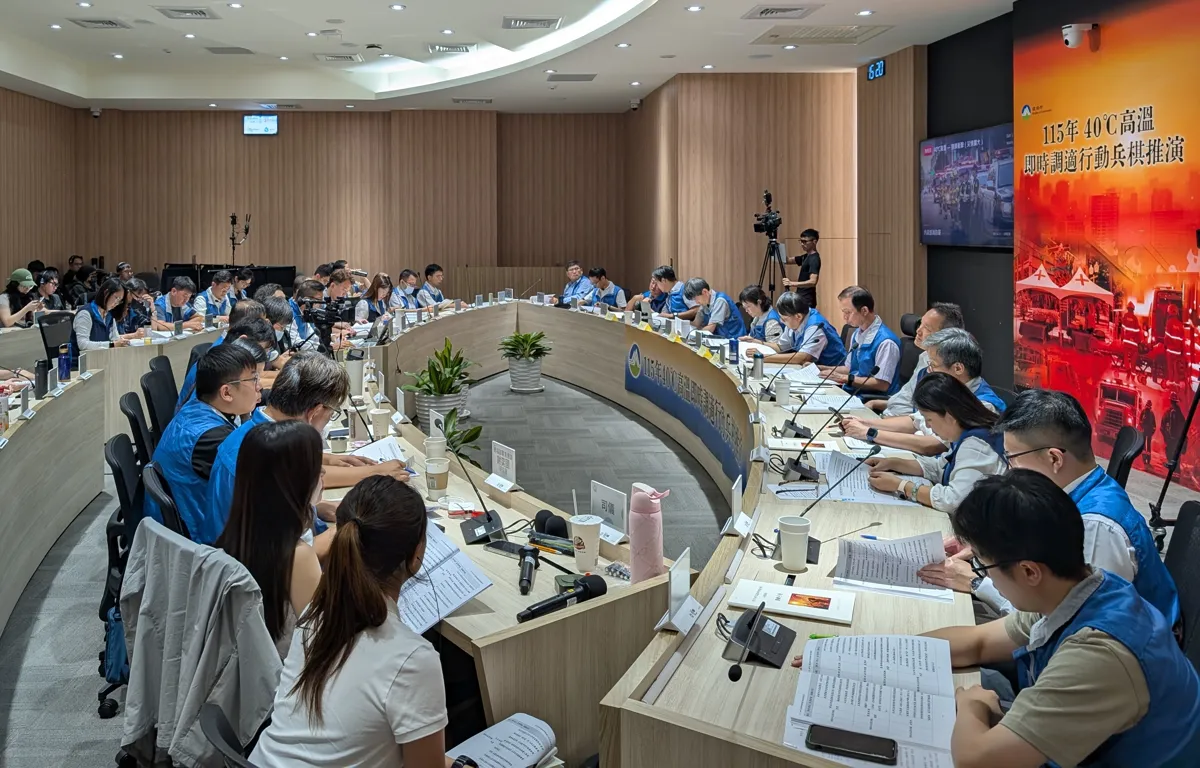
Taiwan’s first nationwide tabletop exercise designed to simulate extreme heat scenarios, examining the potential impacts and response mechanisms if the greater Taipei area were to experience three consecutive days of 40°C temperatures.
On June 29, the Ministry of Environment conducted the “40°C Extreme Heat Immediate Adaptation Action” tabletop exercise, bringing together 34 central and local government agencies to simulate the effects of extreme heat waves on critical infrastructure, including healthcare, electricity, water supply, transportation, and emergency response systems. The scenario assumed that the Central Weather Administration issued a red heat alert, with Taipei, New Taipei, and Taoyuan experiencing temperatures of 40°C for three consecutive days. Such conditions could trigger a surge in electricity demand, causing power outages in certain areas. Hospitals would be forced to activate backup power systems while handling a sharp increase in heat-related emergency cases. Transportation systems could also be affected, with metro rail temperatures exceeding safe limits and requiring train speed reductions, while asphalt roads might soften and deform under extreme heat. At the same time, prolonged high temperatures could increase the risk of forest fires and spontaneous combustion at waste storage sites.
In response to these simulated scenarios, various government agencies proposed emergency measures. Taiwan Power Company would prioritize power dispatch to ensure stable electricity supply for essential services such as healthcare, transportation, and water systems. The Ministry of Health and Welfare would strengthen emergency room triage and inter-regional medical support. The Ministry of Transportation and Communications would require rail systems to enhance temperature monitoring and implement preventive speed restrictions, while also applying traffic controls and road cooling measures to mitigate heat-related road damage. Meanwhile, the Forestry and Nature Conservation Agency would deploy advanced technologies to strengthen wildfire monitoring and firefighting efforts.
Experts emphasized that heat-related risks are not limited to outdoor environments. Indoor spaces can also become dangerous if power outages or air-conditioning failures occur. Facilities highly sensitive to temperature changes—such as kindergartens, hospital intensive care units, long-term care institutions, and dialysis centers—must establish comprehensive backup cooling, power, and water supply systems. In addition, vulnerable populations, including low-income households, elderly people living alone, and homeless individuals, should be integrated into heat adaptation planning through data-driven monitoring and social welfare support systems to ensure timely assistance during extreme heat events.
Overall, the exercise highlighted Taiwan’s growing need to strengthen adaptation measures against extreme heat. At present, extreme heat is categorized as part of climate adaptation under existing climate legislation, but it has not yet been formally recognized as a natural disaster under the Disaster Prevention and Protection Act. This limits the government’s authority in mobilizing resources and implementing mandatory measures. Based on the results of this exercise, the Ministry of Environment plans to include a dedicated “Extreme Heat” chapter in the Fourth National Climate Change Adaptation Action Plan, establishing a clearer cross-agency response framework. A live field exercise is also scheduled for late July to further enhance Taiwan’s resilience against future extreme heat events.
Resources: 當台北熱到停電、路面變形...該怎麼辦? 環境部啟動首次40℃高溫兵棋推演 - 環境資訊中心Disclaimer:
1.The articles compiled and published by this association on the Taiwan Net Zero Emissions Association's official website and in the Member Biweekly Report are for the purpose of introducing international environmental trends and for educational use only, not for profit.
2.Any legal responsibilities or losses resulting from the use or adaptation of articles translated by the association shall be borne solely by the user or adapter.
For more insights on net-zero emissions, feel free to subscribe to our biweekly newsletter:
https://www.tnzea.org.tw/eforms.php?lang=tw&tb=1