
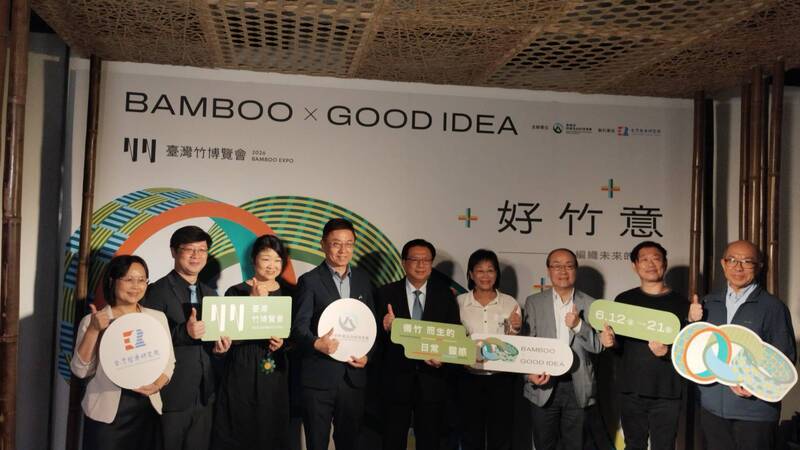
As the world charges toward the global 2050 net-zero emissions mandate, "bamboo"—celebrated for its rapid growth and highly renewable properties—is emerging as an internationally watched green strategic resource. On June 12, the Forestry and Nature Conservation Agency (FANCA) under the Ministry of Agriculture officially kicked off the second biennial "2026 Taiwan Bamboo Expo" at the Songshan Cultural and Creative Park in Taipei. Centered around the theme "Bamboo X Good Idea," this year's expo showcases the material revolution and future sustainability vision of Taiwan's bamboo industry.
FANCA Director-General Lin Hua-ching pointed out that Taiwan is home to over 60 to 70 species of bamboo, with an extensive cultivation area reaching approximately 183,000 hectares, providing excellent foundations for industrial development. However, over the past 30 years, Taiwan's bamboo industry has gradually declined, facing critical challenges such as labor shortages and the need for technical revitalization, which left bamboo products relegated to the realm of traditional memories. With modern technological advancements, applications for bamboo have expanded into high-value sectors like bamboo fiber. To revitalize this sustainable industry, FANCA has committed to hosting the Bamboo Expo every two years to boost market visibility.
To actively stimulate the bamboo supply chain from a policy perspective, the Ministry of Agriculture officially announced amendments to the "Incentive Regulations for Bamboo Forest Production and Renewal" this year. While the previous incentive program was restricted to logging-ban zones within Indigenous reserved lands, the amended regulations have significantly expanded eligibility to encompass "all forestry lands". FANCA stated that the new framework pivots from merely encouraging logging renewal to a comprehensive reward system that integrates forest management, material production, and industrial application. Moving forward, any forest owners cultivating economic bamboo species—such as Moso, Makino, or Long-branch bamboo—can apply for incentives, which is expected to effectively motivate owners to reinvest in management and stabilize the domestic supply of green materials.
Following the grand opening of the main pavilion in Taipei, the "2026 Taiwan Bamboo Expo" will roll out a series of diverse exhibitions over the next three months across six satellite exhibition zones: Hsinchu, Taichung, Nantou, Hualien, Pingtung, and Yunlin. Through this dual approach of policy incentives and public expos, the government aims to overcome the industry's technical rebuilding challenges and seamlessly reintegrate carbon-reducing bamboo products back into everyday public life.
Disclaimer:
1.The articles compiled and published by this association on the Taiwan Net Zero Emissions Association's official website and in the Member Biweekly Report are for the purpose of introducing international environmental trends and for educational use only, not for profit.
2.Any legal responsibilities or losses resulting from the use or adaptation of articles translated by the association shall be borne solely by the user or adapter.
For more insights on net-zero emissions, feel free to subscribe to our biweekly newsletter:
https://www.tnzea.org.tw/eforms.php?lang=tw&tb=1