
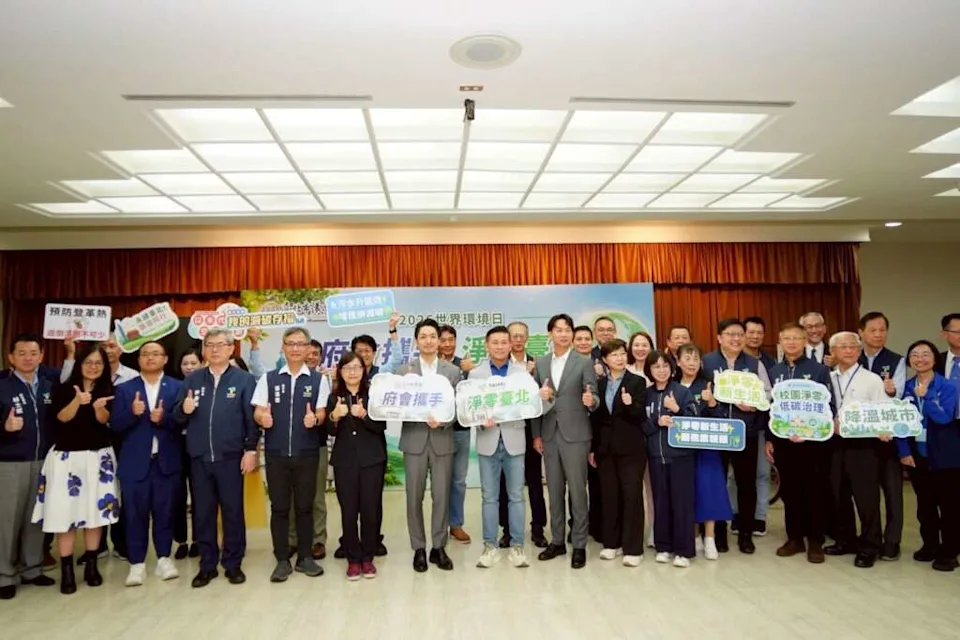
In response to global climate change and to demonstrate its commitment to building a sustainable city, Taipei Mayor Chiang Wan-an attended the "Joint Executive-Legislative Declaration for Net-Zero" ceremony today. During the event, Mayor Chiang emphasized that the city government and the city council will work closely together to fully advance urban transformation. He reaffirmed Taipei's goal to achieve net-zero emissions by 2050, leading citizens toward a green, eco-friendly, and low-carbon future.
In his address, Chiang stated that extreme weather poses direct challenges to urban operations and daily life. Net-zero carbon emissions is no longer just an environmental initiative, but a critical transformation tied to Taipei's urban competitiveness. He extended special thanks to the city council for its support of sustainability policies, noting that their review of regulations and budget allocations has enabled various green innovative policies to be successfully implemented.
Three Core Strategies to Accelerate Green Urban Transformation
The Taipei City Government indicated that future efforts will focus on three major transitional strategies to accelerate the carbon reduction timeline:
Smart Green Transportation: Continually promoting the full electrification of public buses, expanding the deployment of shared vehicles and the YouBike 2.0 system, and optimizing low-carbon transit hubs to increase the utilization rate of public transportation.
Building Energy Efficiency Transformation: Implementing stricter energy efficiency assessments for public and new buildings, and encouraging existing private buildings to undergo green retrofitting and energy-saving equipment replacements through subsidies and guidance mechanisms.
Circular Economy and Everyday Practice: Starting waste reduction at the source by promoting paperless digital services, and collaborating with commercial districts and enterprises to integrate low-carbon consumption into citizens' daily lives.
Consensus Between Executive and Legislative Branches to Build a Sustainable and Resilient Taipei
City council representatives echoed these sentiments at the event, stating that the net-zero transition requires cross-party and cross-generational efforts. In the future, besides strictly supervising the progress of policy execution, the council will also serve as a bridge between citizens and the city government. This ensures that a "just transition" is fulfilled during the move toward a low-carbon future, safeguarding workers and vulnerable groups affected by industrial transformation.
Chiang Wan-an concluded by emphasizing that "2050 Net-Zero Emissions" is a long but must-win marathon. The city government will lead by example, starting with the public sector by promoting green procurement and smart energy management. He hopes that through executive-legislative cooperation, private enterprises and all citizens will be inspired to participate, making Taipei a leading low-carbon city for sustainable development in Asia.
Resources: https://tw.news.yahoo.com/%E5%BA%9C%E6%9C%83%E6%94%9C%E6%89%8B%E6%8E%A8%E6%B7%A8%E9%9B%B6-%E8%94%A3%E8%90%AC%E5%AE%89-2050%E9%81%94%E6%B7%A8%E6%8E%92%E6%94%BE%E9%82%81%E5%90%91%E4%BD%8E%E7%A2%B3%E6%9C%AA%E4%BE%86-094042556.html?guccounter=1&guce_referrer=aHR0cHM6Ly93d3cuYmluZy5jb20v&guce_referrer_sig=AQAAANQERM7D1ItOOXtrbd60Bi5xuTGoxzvDtEfUvQN3g5_R0njO_zvT7OZyPaJYZbgIept5FVKu1UR3ayrcZxw3ClaCxCXiRC9mXOiTXTnFG1lCDRVDp_NsbLc1EKwSXWI45OjH_n7yVeHntxXchGJ8wiebqWmjq-II_dsERY4G0xR5
Disclaimer:
1.The articles compiled and published by this association on the Taiwan Net Zero Emissions Association's official website and in the Member Biweekly Report are for the purpose of introducing international environmental trends and for educational use only, not for profit.
2.Any legal responsibilities or losses resulting from the use or adaptation of articles translated by the association shall be borne solely by the user or adapter.
For more insights on net-zero emissions, feel free to subscribe to our biweekly newsletter:
https://www.tnzea.org.tw/eforms.php?lang=tw&tb=1