

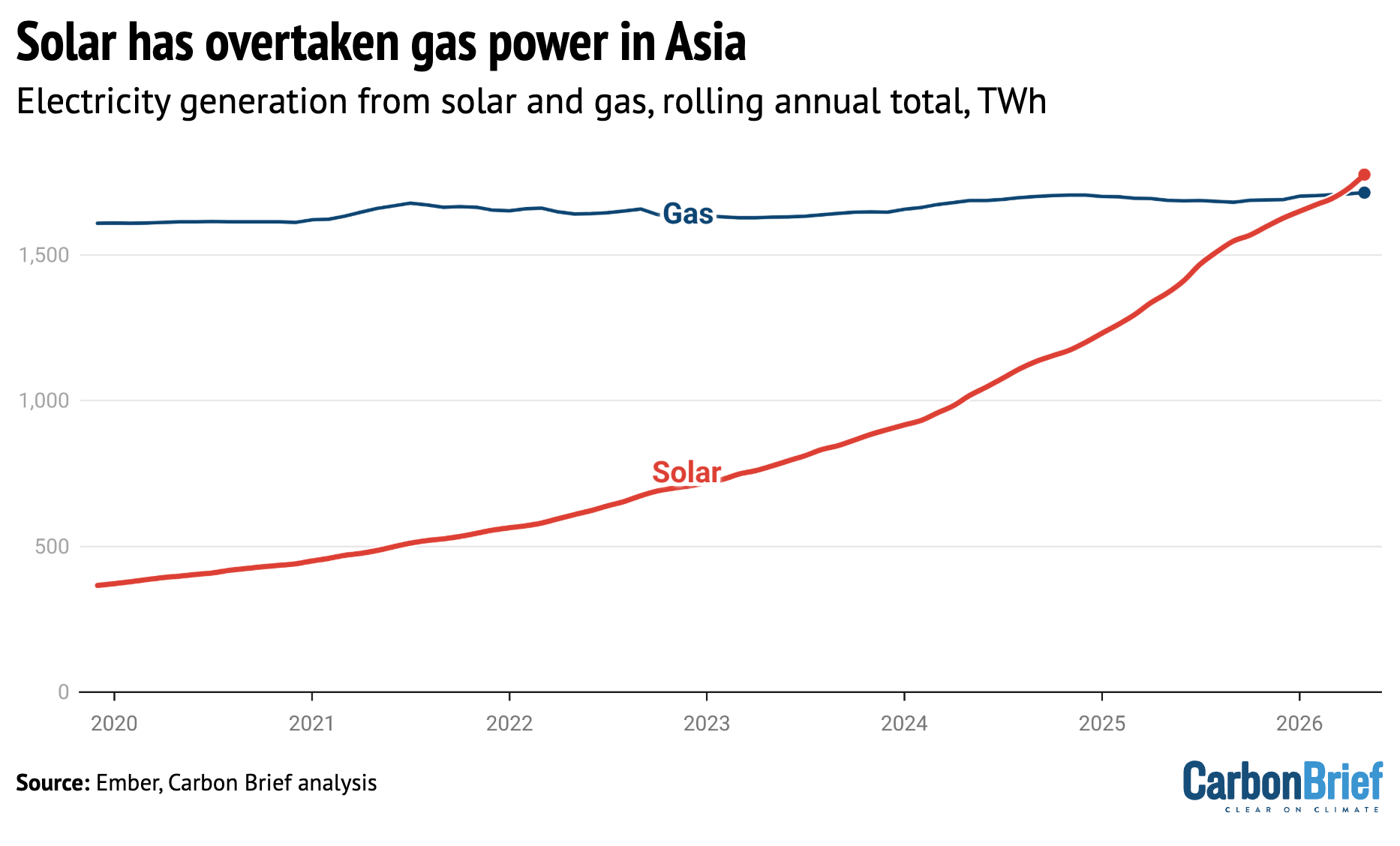
Solar power has overtaken gas to become Asia’s third-largest source of electricity, marking a major milestone in the region’s energy transition. According to Carbon Brief, solar generation in Asia reached 1,727 TWh in the 12 months to April 2026, slightly surpassing gas generation at 1,711 TWh.
Since 2020, Asia’s solar output has nearly quadrupled, accounting for around 60% of global solar growth. This rapid expansion has been driven primarily by China, which contributed nearly three-quarters of the region’s solar growth and now dominates global solar manufacturing with over 80% of production capacity.
Meanwhile, gas power growth in Asia has stalled despite earlier expectations of rapid expansion. High LNG prices, supply disruptions following the Russian invasion of Ukraine, infrastructure delays, and stronger competition from renewables have weakened gas’s role. Although gas capacity increased by 22% from 2019–2024, actual gas-fired generation rose only 6%.
Coal remains Asia’s largest electricity source at 52%, followed by hydropower at 12%. However, the rapid rise of solar signals a major shift in Asia’s power mix. Falling solar costs, strong deployment in countries like India and Pakistan, and growing concerns over energy security are accelerating the region’s transition toward cleaner energy.
Image/Source: Analysis: Solar overtakes gas power in Asia for first time ever - Carbon Brief
Disclaimer:
-
Articles translated and published by the Taiwan Net Zero Emissions Association on its official website and in the Members’ Biweekly Newsletter are intended solely to introduce international environmental trends and for educational purposes, and are not used for commercial gain.
-
Any legal liability or loss arising from the use or adaptation of the Association’s translated articles shall be borne solely by the user or adapter.