

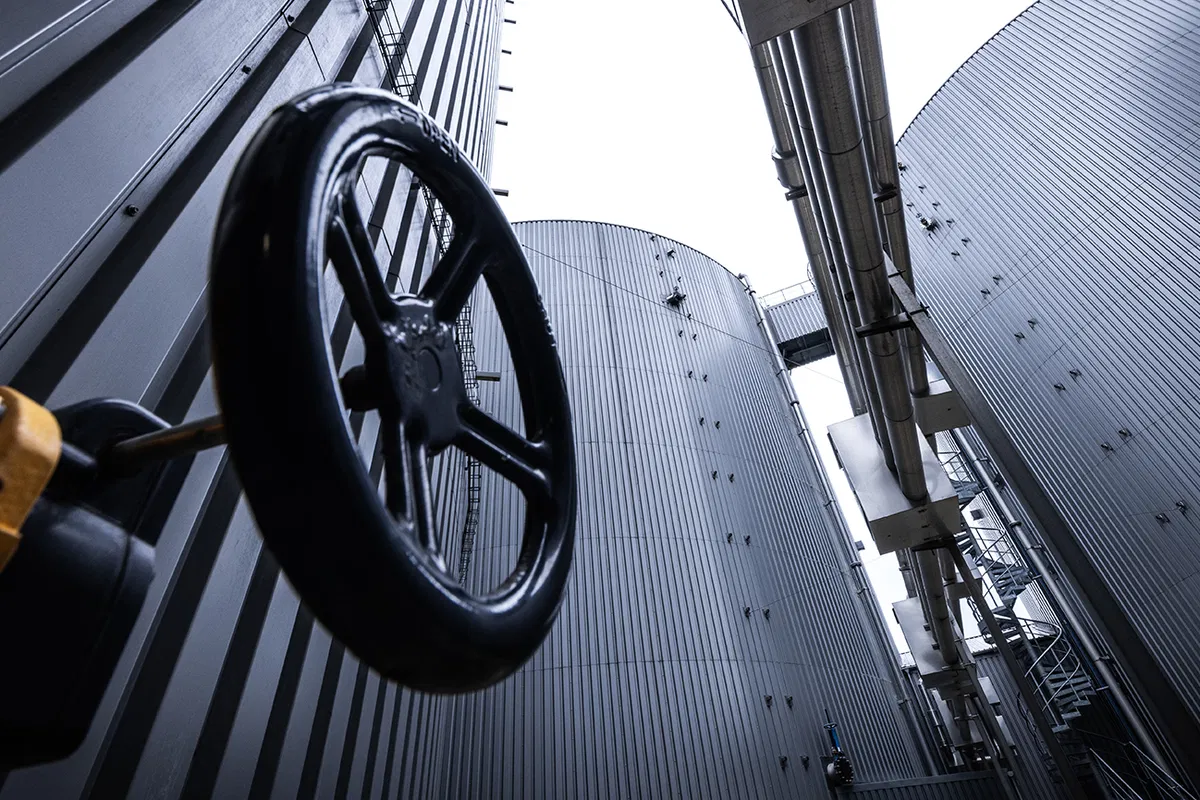
Danish biogas pioneer Bigadan officially inaugurated its brand-new CO2 capture facility at Kalundborg Bioenergy on May 20, 2026.
▍ Core Technical and Policy Indicators
-
Commercialization of Biogenic CO2: The facility specifically captures CO2 generated during biogas production feedstock sourced from agricultural and industrial residues.
Since biogenic carbon is part of the natural biological cycle, trapping it permanently underground results in a net removal of CO2 from the atmosphere (achieving negative emissions). -
Annual Capacity of 27,000 Tonnes: The Kalundborg facility is projected to capture 27,000 tonnes of CO2 annually.
-
Integration with Project Greensand: Once captured and liquefied, the CO2 will be transported for permanent geological storage in the Danish sector of the North Sea as part of the established Project Greensand consortium.
-
2030 Strategic Scaling Expansion: Building upon its operational facility in Horsens and an upcoming site in Herning, Bigadan aims to deploy CO2 capture across all its Danish biogas plants.
By 2030, the company expects to capture up to 200,000 tonnes of CO2 per year—equivalent to offsetting the annual emissions of roughly 100,000 petrol cars.
▍ Industrial Drive and Strategic Significance
-
Transitioning from Pledges to Practice: Henrik Iversen, Chief Commercial Officer (CCO) of Bigadan, stated that the realization of this commercial value chain signals that carbon management is no longer merely a pilot concept but the definitive inception of a new commercial industry.
-
Positioning Denmark as a Central CCS Hub: Subsea carbon storage in the North Sea is increasingly recognized as an indispensable technology for the European green transition.
Leveraging its vast depleted offshore reservoirs and regulatory frameworks, Denmark is well-positioned to become a central European hub for permanent carbon storage. -
Cross-Sector Alliance: The inauguration ceremony brought together key political and industrial leaders, including Søren Pind, Chairman of Biogas Denmark, and Martin Damm, Mayor of Kalundborg, emphasizing the project's regional economic value and national energy strategic prominence.
▍ Market Perspectives and Potential Challenges
-
Proponents' View: Market analysts point out that this integrated value chain proves that organic waste processing can simultaneously deliver renewable energy (biomethane) and monetize carbon dioxide removal (CDR). This opens up lucrative new revenue streams through high-quality carbon removal credits for biogas producers.
-
Critics' View: Energy experts caution that biogas production plants are inherently decentralized. The long-term commercial sustainability of this model—without indefinite government subsidies—will heavily depend on minimizing midstream logistics and transport costs from rural inland generation plants to offshore injection points.
Disclaimer:
-
Articles translated and published by the Taiwan Net Zero Emissions Association on its official website and in the Members’ Biweekly Newsletter are intended solely to introduce international environmental trends and for educational purposes, and are not used for commercial gain.
-
Any legal liability or loss arising from the use or adaptation of the Association’s translated articles shall be borne solely by the user or adapter.