
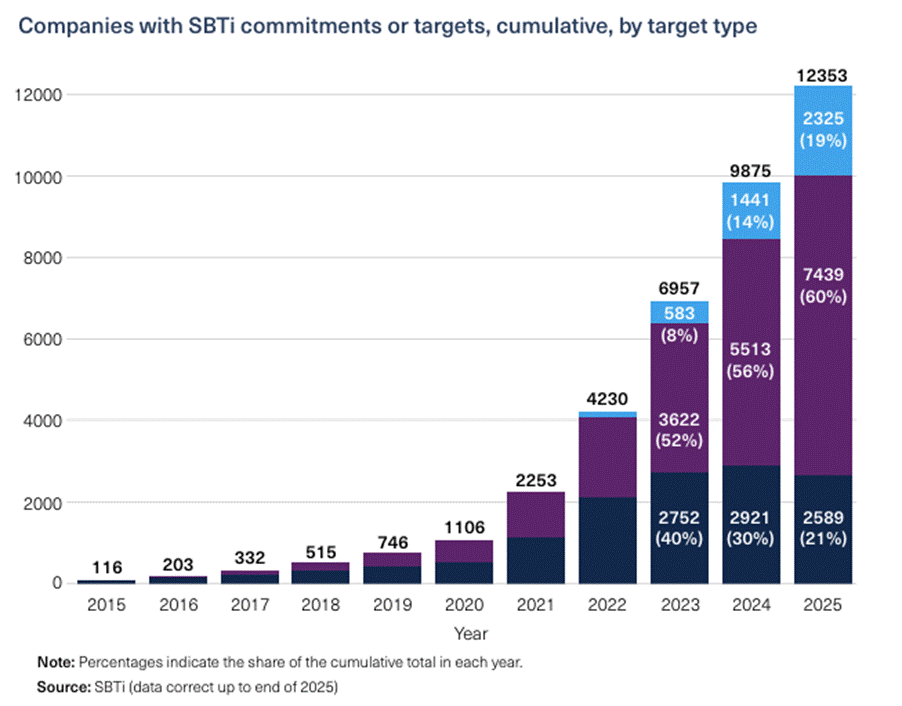
The global corporate transition to green operations has officially entered a phase of "live-fire" implementation. According to the latest trend report released by the Science Based Targets initiative (SBTi), the number of companies worldwide with verified science-based emission reduction targets has historically surpassed the 10,000 mark by early 2026. This milestone signals that science-based carbon reduction has evolved from a mere public relations slogan for a handful of pioneers into a collective action and common language across global commercial supply chains.
🌍 Surging Ambition: Nearly 40% of Companies Aim Directly for "2050 Net-Zero"
The report highlights that the number of certified companies grew by a staggering 40% over the past year, reflecting the urgency felt by businesses facing global climate change and supply chain compliance pressures. More notably, enterprises are demonstrating a deeper, long-term commitment—the number of companies setting both "near-term targets" and "long-term Net-Zero targets" surged by 61%. Currently, Net-Zero commitments account for 40% of all verified targets, showing that corporations are dedicated to thoroughly overhauling their existing operational models.
🎯 Pivot to the East: Asia Becomes the Powerhouse of Global Climate Action
While Europe still maintains an advantage in terms of the total volume of certified companies, the latest data reveals that the strongest momentum for global climate action has unmistakably "shifted to the East." The Asian region achieved a 53% annual growth rate over the past year, far outpacing the global average.
Within Asia, Japan continues to lead the region with 2,091 certified companies, making it the country with the highest total volume globally. China, one of the world's largest carbon emitters, saw an explosive corporate certification growth rate of 92% (with its information technology sector achieving an astonishing 145% growth). Taiwan has also performed exceptionally well amidst this Asian green wave, ranking at the forefront of regions classified as "high-penetration markets." Alongside key economies like Japan and South Korea, Taiwanese enterprises are leveraging their pivotal roles in global value chains to drive regional technological innovation and influence global decarbonization progress through supply chain ripple effects.
🪄 Capital Reshuffling: Industrials and Healthcare Race Ahead as Carbon Reduction Becomes a Stock Market Standard
In terms of sectors, the traditional heavy-emitting "Industrials" sector stands at the vanguard of climate action, accounting for 30% of the global total of certified companies. Meanwhile, the "Healthcare" sector has accelerated the integration of climate ambitions into its long-term development plans in the post-pandemic era, emerging as the fastest-growing dark horse with a 76% annual growth rate.
This green wave has embedded itself deeply into the core of global capital markets. In Europe, science-based targets have become a baseline survival requirement for large enterprises; 70% of the constituents of France's CAC 40 index have set targets, while Germany's DAX 40 and the UK's FTSE 100 stand at 68% and 53% penetration respectively. Asian financial markets are catching up rapidly, with nearly half (49%) of the components of Japan's Nikkei 225 index onboard. As the world enters the "decisive decade" of climate action, setting SBTi targets is no longer an elective option—it is a mandatory path for enterprises to build resilience under strict regulatory environments and secure the confidence of international investors.
Resources: https://sciencebasedtargets.org/news/corporate-climate-target-setting-up-40-in-2025-with-asia-emerging-as-a-centre-of-gravity
Disclaimer:
1.The articles compiled and published by this association on the Taiwan Net Zero Emissions Association's official website and in the Member Biweekly Report are for the purpose of introducing international environmental trends and for educational use only, not for profit.
2.Any legal responsibilities or losses resulting from the use or adaptation of articles translated by the association shall be borne solely by the user or adapter.
For more insights on net-zero emissions, feel free to subscribe to our biweekly newsletter:
https://www.tnzea.org.tw/eforms.php?lang=tw&tb=1
🌍 Surging Ambition: Nearly 40% of Companies Aim Directly for "2050 Net-Zero"
The report highlights that the number of certified companies grew by a staggering 40% over the past year, reflecting the urgency felt by businesses facing global climate change and supply chain compliance pressures. More notably, enterprises are demonstrating a deeper, long-term commitment—the number of companies setting both "near-term targets" and "long-term Net-Zero targets" surged by 61%. Currently, Net-Zero commitments account for 40% of all verified targets, showing that corporations are dedicated to thoroughly overhauling their existing operational models.
🎯 Pivot to the East: Asia Becomes the Powerhouse of Global Climate Action
While Europe still maintains an advantage in terms of the total volume of certified companies, the latest data reveals that the strongest momentum for global climate action has unmistakably "shifted to the East." The Asian region achieved a 53% annual growth rate over the past year, far outpacing the global average.
Within Asia, Japan continues to lead the region with 2,091 certified companies, making it the country with the highest total volume globally. China, one of the world's largest carbon emitters, saw an explosive corporate certification growth rate of 92% (with its information technology sector achieving an astonishing 145% growth). Taiwan has also performed exceptionally well amidst this Asian green wave, ranking at the forefront of regions classified as "high-penetration markets." Alongside key economies like Japan and South Korea, Taiwanese enterprises are leveraging their pivotal roles in global value chains to drive regional technological innovation and influence global decarbonization progress through supply chain ripple effects.
🪄 Capital Reshuffling: Industrials and Healthcare Race Ahead as Carbon Reduction Becomes a Stock Market Standard
In terms of sectors, the traditional heavy-emitting "Industrials" sector stands at the vanguard of climate action, accounting for 30% of the global total of certified companies. Meanwhile, the "Healthcare" sector has accelerated the integration of climate ambitions into its long-term development plans in the post-pandemic era, emerging as the fastest-growing dark horse with a 76% annual growth rate.
This green wave has embedded itself deeply into the core of global capital markets. In Europe, science-based targets have become a baseline survival requirement for large enterprises; 70% of the constituents of France's CAC 40 index have set targets, while Germany's DAX 40 and the UK's FTSE 100 stand at 68% and 53% penetration respectively. Asian financial markets are catching up rapidly, with nearly half (49%) of the components of Japan's Nikkei 225 index onboard. As the world enters the "decisive decade" of climate action, setting SBTi targets is no longer an elective option—it is a mandatory path for enterprises to build resilience under strict regulatory environments and secure the confidence of international investors.
Resources: https://sciencebasedtargets.org/news/corporate-climate-target-setting-up-40-in-2025-with-asia-emerging-as-a-centre-of-gravity
Disclaimer:
1.The articles compiled and published by this association on the Taiwan Net Zero Emissions Association's official website and in the Member Biweekly Report are for the purpose of introducing international environmental trends and for educational use only, not for profit.
2.Any legal responsibilities or losses resulting from the use or adaptation of articles translated by the association shall be borne solely by the user or adapter.
For more insights on net-zero emissions, feel free to subscribe to our biweekly newsletter:
https://www.tnzea.org.tw/eforms.php?lang=tw&tb=1