

The 30th UN Climate Change Conference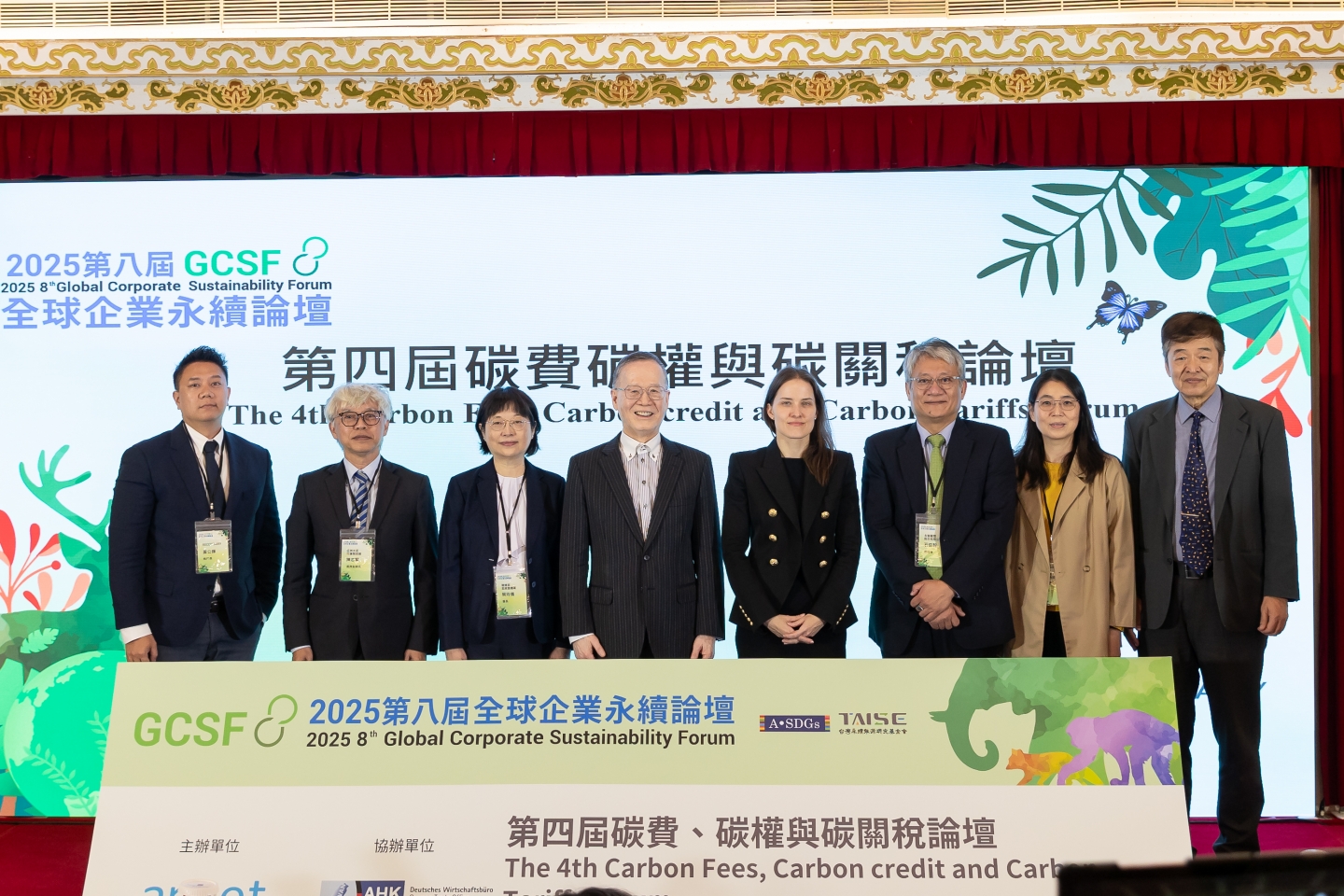
Side Event of the “2025 8th GCSF Global Corporate Sustainability Forum” —
4th Carbon Fee, Carbon Credit & Carbon Tariff Forum
Hosted by Association for Net-Zero Emissions Taiwan
The Association for Net-Zero Emissions Taiwan held the “4th Carbon Fee, Carbon Credit & Carbon Tariff Forum” on November 25 at the Grand Hotel Taipei, Duen-Mou Hall, as one of the major sub-forums of the 2025 8th GCSF Global Corporate Sustainability Forum. This year’s forum focused on Taiwan’s upcoming 2026 carbon pricing policies, global carbon market trends, industrial low-carbon transformation practices, and financial impacts under carbon pricing. More than 300 representatives from government agencies, international organizations, multinational corporations, the energy and manufacturing sectors, and the carbon management service industry attended, gathering stakeholders across the public sector, businesses, and academia to explore key strategies and challenges for Taiwan’s net-zero transition.
The forum opened with remarks delivered by Ambassador Eugene Chien, Chairman of the Taiwan Net-Zero Emissions Association, and Dr. Axel Limberg, Chief Representative of the German Trade Office Taipei. A panel discussion was moderated by Distinguished Professor Yang Gu of National Taiwan University of Science and Technology. The forum further analyzed Taiwan’s dual-track approach to carbon pricing—implementing a carbon fee while piloting an Emissions Trading System (ETS)—which marks a critical policy milestone as the nation enters its first year of carbon pricing.
Launch of 2026 Carbon Pricing: Dual Implementation of Carbon Fees and ETS to Strengthen International Alignment
Director-General Ling-Yi Tsai of the Climate Change Administration, Ministry of Environment, explained that the launch of the carbon fee and the pilot ETS will help bring the energy and industrial sectors under regulatory control, paving the way toward a full-economy ETS. The new measures can connect Taiwan to developments in the EU, U.S., and Asia-Pacific carbon markets while enhancing incentives for industrial transformation. She noted that blue carbon, forest carbon, and soil carbon credits are gaining importance as international voluntary carbon market (IC-VCM, VCMI) standards drive improvements in credit quality.
Global Carbon Market Insights: High-Quality Carbon Credits Becoming the International Mainstream
Robert Shih, CEO of YC Holdings, emphasized that high-quality carbon credits are now the mainstream in global markets and that transparency in supply chain carbon data is imperative. He noted that as international carbon management standards continue to rise, supply chains will face increasingly stringent requirements. According to ICAP 2025 data, 11 carbon trading systems worldwide are under development and 9 more are under consideration. Japan will also begin levying a carbon tax on imported fossil fuels in 2028. While voluntary carbon markets (VCM) remain non-mandatory, forestry, renewable energy, and community-based mitigation projects continue to play an important role, and high-quality credits (CCP) are expected to become the dominant choice for corporate procurement.
Industrial Low-Carbon Transition Case Studies: Cement and Tech Sectors Demonstrate Diverse Strategies
Cement Sector:
Aisa Cement (ACC) Hualien Plant’s Deputy Chief Vice Director, Chih-Hsien Chen, shared low-carbon manufacturing innovations in the cement industry. Since process emissions from limestone calcination account for about 57% of total emissions, the sector faces significant decarbonization challenges. ACC has implemented strategies such as alternative materials, alternative fuels, and reduced clinker content, while employing blockchain technology to enhance transparency in carbon credit transactions. ACC has also advanced practices in waste turbine blade treatment, renewable-energy waste management, and habitat restoration, demonstrating achievements in circular economy and local sustainability.
Technology Sector:
AUO’s Sustainability Strategy Director, Ms. Wei, highlighted how technological governance supports net-zero transition. AUO has established the “One Data Carbon Management Platform” covering Scope 1–3 emissions, implemented ISO 50001 and IPMVP mechanisms, deployed over 20,000 IoT sensors, and accumulated close to 10,000 energy-saving projects. AUO has completed 524 MW of renewable energy installations and monitors more than 7,000 solar power stations in Taiwan. The company has also initiated early-stage carbon credit sales to help businesses mitigate potential carbon fee impacts.
Financial Impacts of Carbon Pricing:
Reccsssary CEO, Kung-Hui Huang, emphasized that carbon pricing poses significant financial risks for emissions-intensive industries such as chemicals, steel, semiconductors, cement, and photovoltaics, affecting financial statements, capital expenditure, and investment decisions. Companies that actively reduce emissions can lower over 90% of their potential carbon fee burden while generating additional revenue through carbon credit transactions. High-quality carbon credits and transparent carbon information will be critical for corporate risk management.
Panel Discussion Highlights: Cross-Sector Collaboration, Innovation, and Market Mechanisms as Core Drivers for Net-Zero
In the panel moderated by Professor Gu, speakers and participants discussed face-to-face how cross-sector collaboration, technological innovation, and market-based mechanisms form the three core drivers of net-zero progress. As Taiwan enters its first year of carbon pricing, companies should:
-
Integrate carbon costs into financial planning
-
Build data-driven management capabilities and strengthen supply chain collaboration
-
Begin early deployment of carbon credit assets and reduction strategies
-
Monitor CBAM and global carbon border policies
-
Actively adopt emerging technologies such as CCUS and blockchain
CCUS application in the cement industry will be a critical breakthrough area, with expectations for early pilot demonstration at local facilities.
Future Directions of the Taiwan Net-Zero Emissions Association
Chairman Eugene Chien stated that the Association will continue advancing:
-
Public-private-academic exchange and policy communication
-
Corporate carbon management capacity-building
-
Thematic research and technology deployment
-
Support for businesses responding to carbon fees, emissions trading, and global carbon border policies
Dr. Eva Langerbeck, Head of German Trade Office Taipei also emphasized that the EU CBAM has become an essential policy tool shaping global corporate competitiveness and commended the forum for providing valuable insights to Taiwanese businesses.
Disclaimer:
1.The articles compiled and published by this association on the Taiwan Net Zero Emissions Association's official website and in the Member Biweekly Report are for the purpose of introducing international environmental trends and for educational use only, not for profit.
2.Any legal responsibilities or losses resulting from the use or adaptation of articles translated by the association shall be borne solely by the user or adapter.
For more insights on net-zero emissions, feel free to subscribe to our biweekly newsletter:
https://www.tnzea.org.tw/eforms.php?lang=tw&tb=1